
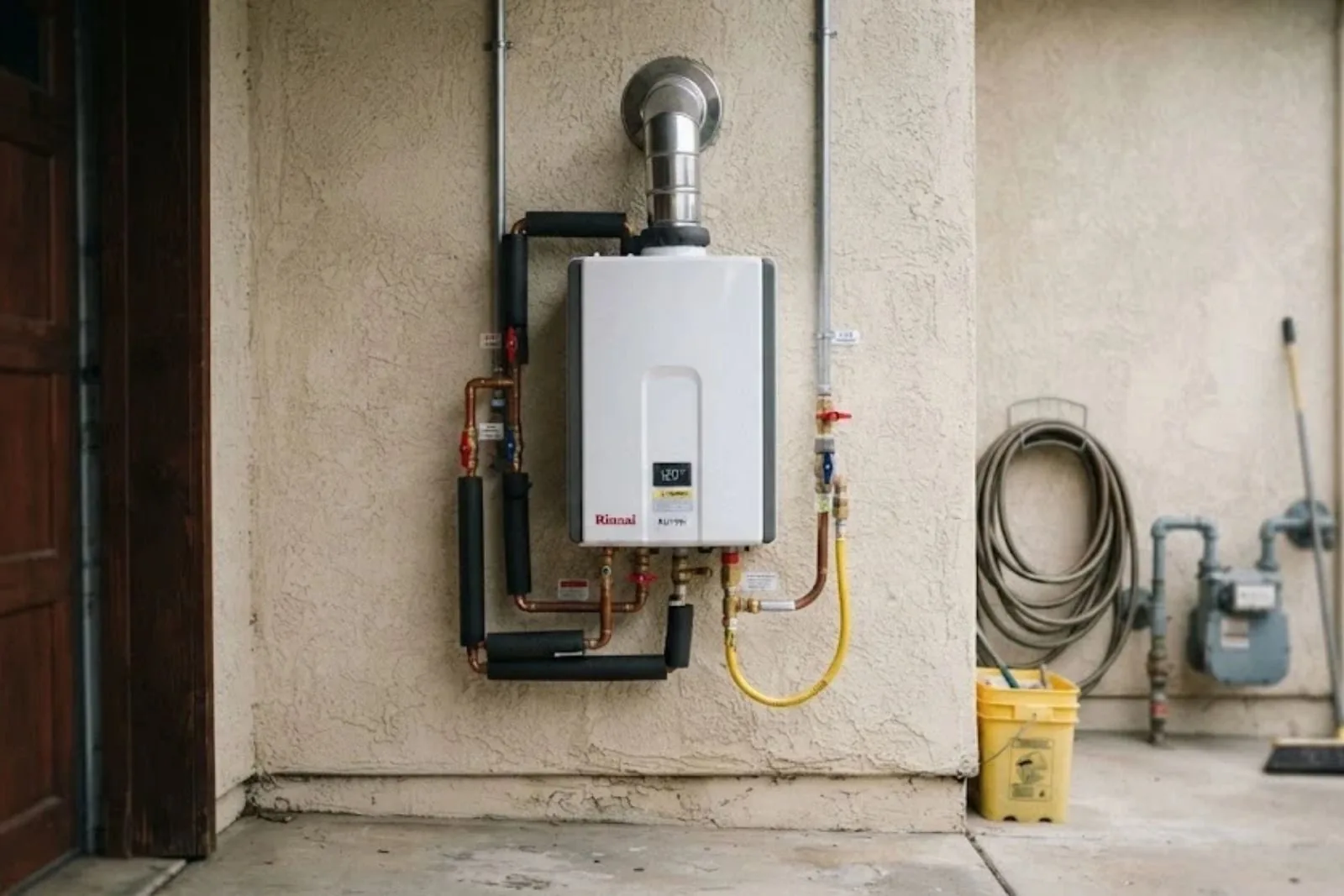
A gas tankless water heater vents exhaust outdoors through a sealed or open pipe, depending on the model. Direct vent units pull air in from outside and push exhaust out. Atmospheric units use room air.
Pipe type, length, and clearances come from the maker's instructions and local code, not from guesswork. Call (303) 552-3896 and a licensed plumber can walk through the route with you.
Two venting styles and what they ask of your house
The unit's label tells you which style it is. The choice changes everything about the pipe.
Direct vent (sealed)
- Draws combustion air from outdoors.
- Pushes exhaust out through its own pipe.
- Often uses a two-pipe or concentric kit.
- Less affected by room air and tight homes.
- Needs a wall or roof termination.
Atmospheric (room air)
- Draws combustion air from the room.
- Needs enough open air around the unit.
- Exhaust goes up a flue.
- Can pull on a tightly sealed house.
- Less common on newer high-efficiency models.
Why venting is the part you cannot improvise
Exhaust from a gas burner carries carbon monoxide. If it leaks into the house or gets sucked back in, people get sick. That is why every maker publishes exact rules for pipe type, size, and length.
A vent that looks fine to the eye can still be wrong. The wrong pipe can warp from heat. Poor joints can leak exhaust. A termination in the wrong place can feed fumes back inside. Treat the manual as the first source and local code as the second.
Vent materials in general terms
The right choice is whatever the manual lists for your exact model.
| Vent type | Typical use | Plain-language note |
|---|---|---|
| Stainless steel | Higher-temperature exhaust or older style units. | Strong and long-lasting, but costly to run in long routes. |
| Plastic pipe approved by the maker. | Cooler high-efficiency exhaust | Light and easy to route, but only if the manual allows it. |
| Concentric kit | Air in and exhaust out in one fitting. | Cuts the number of wall holes. |
| Existing flue | Reuse when the maker allows it. | Needs inspection and often a liner. |
Never mix pipe brands or types unless the manual clearly says you can.
How a vent route gets planned
A plumber follows a sequence like this before cutting a single hole.
- Read the manual.The model's instructions list pipe type, maximum length, number of elbows, and termination rules.
- Choose the exit.Pick a wall or roof exit that stays clear of windows, doors, vents, and walkways.
- Measure the run.Count straight pipe and every turn, because each one reduces the allowed length.
- Seal and support.Joints are made as the maker directs and the pipe is slope-checked and supported.
- Test the burner.After startup, the exhaust is checked and the unit is watched through a full cycle.
Clearances belong to the manual and the code
Distances from windows, doors, meters, and the ground are set by the manufacturer instructions and local code. We do not quote numbers here, because the wrong number from a web page can put exhaust where it should not be. Ask the plumber to show you the page in the manual that they used.
Snow and drifting matter on the Front Range. A termination too low to the ground can be covered after a storm, which blocks the exhaust. Ask where yours will sit and how it will be kept clear.
Condensate from high-efficiency units
High-efficiency models pull so much heat out of the exhaust that water vapor turns to liquid inside the unit. That liquid is acidic. It has to drain to a safe place, and a plain copper pipe or the wrong drain can be damaged by it.
Many installs use a small neutralizer cartridge that raises the pH before the water goes down a drain. In some spots, a pump is needed to lift it to a drain. Ask where yours will go and how the cartridge is checked.
Mistakes that show up on poorly vented installs
The most common error is a run that is too long or has too many turns. Each elbow works like extra pipe, so a route that looks short can break the maker's limit. The unit may still run, but it can shut down on error codes or burn poorly.
Another is pipe that slopes the wrong way. Condensate has to drain back toward the unit or a drain point, not pool in a low spot. A third is a termination placed near a window or an air intake, which lets exhaust drift back indoors.
A fourth is mixing parts from different makers. Vent parts are tested as a system with the heater, and an off-brand elbow can leak at the joint. If an installer suggests it, ask to see the manual page that allows it.
Warning signs that a vent needs attention
If you see any of these on an existing unit, stop using it and call.
- Soot or staining near the unit.This points to poor combustion or leaking exhaust.
- Sagging or loose pipe.Joints can open when pipe is not supported.
- Water dripping from the vent.May point to condensate in the wrong spot.
- Carbon monoxide alarm sounding.Go outside first, then call the gas utility or 911.
- Error codes tied to exhaust.The unit has shut down for a reason, so do not reset repeatedly.
What this means for choosing between models
Before picking a unit, ask where it will vent and how long the run will be. That decision often matters more than the model name. Learn more on the tankless water heater page and see how plumbing installation work is planned before the first hole gets cut.
Venting rules in Firestone, CO
Firestone sits at about 4,856 feet. Gas burners lose some output at altitude, and the manual often has settings or notes for it, so ask your installer which setting applies to your unit. Venting rules follow the manufacturer instructions, and Colorado has adopted the 2021 International Plumbing Code (IPC) as its base standard. The Firestone building division enforces it through permits and inspections, so ask what applies to your vent.
For vent permits and inspection, the Firestone building division can say what your address needs. If your property is in unincorporated Weld County, the Weld County Building Department covers it instead. Homes near Dacono may fall under a different city, so check which office applies. In Erie the vent rules come from that town's building department, not from us.
Questions homeowners ask
Sometimes, but not often as-is. The old flue may be too large, rusted, or the wrong material. The maker's manual says if reuse is allowed and whether a liner is required.
Many units can exit through a wall. The manual sets the options, and the clearances around the exit decide if a wall is allowed.
It can be, because it is acidic. A neutralizer or a drain made for it is the usual answer, and your plumber should tell you where it goes.
Get everyone outside right away, then call the gas utility or 911. Do not use switches, phones inside, or flames. Wait for the gas utility to clear the home.
Often it does, since air is thinner here than at sea level. The manual lists any altitude settings, and an installer sets them during startup.