
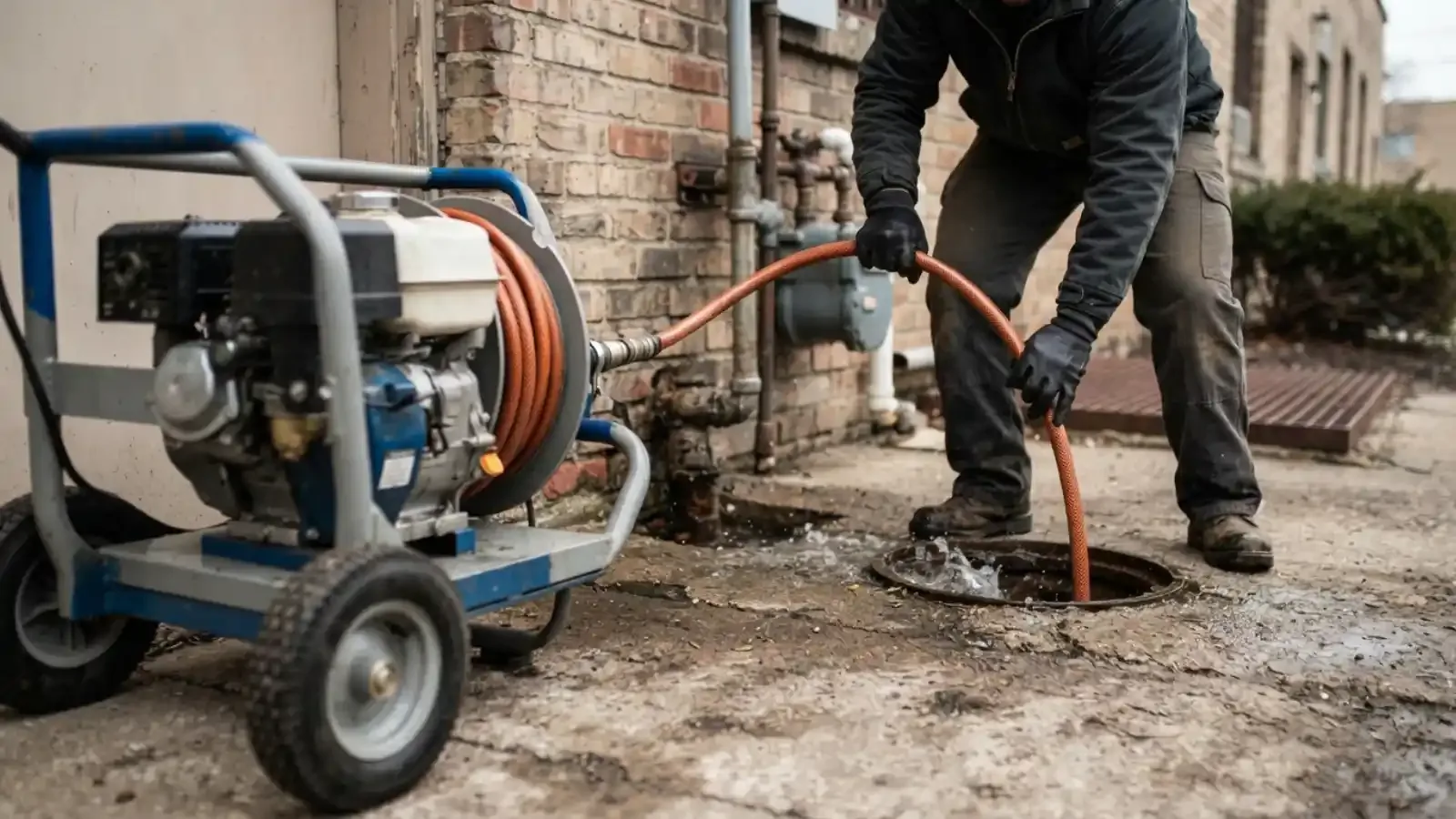
Hydro jetting in Firestone, CO uses a hose and a nozzle that fires pressurized water against the pipe wall, stripping grease, scale, and root hair out of the line. Backups reach us on our 24/7 emergency line. Until a plumber arrives, keep water off, leave the affected drain alone, and stay out of standing water.
A cable punches a hole through a clog. A jet cleans the whole circle of the pipe, which is why it suits a line that keeps stopping up. We often pair it with a camera so the pipe is checked before and after.
Not every blockage needs a jet, and some pipes should not take one. We say so on the phone, and the honest answer is sometimes a standard drain cleaning instead.
What the nozzle does inside the pipe
The nozzle sends several streams backward, and that thrust pulls the hose forward through the line. One forward stream breaks into the blockage while the rear streams scrub the walls on the way back. The result is a pipe that is open across its full width, not just a narrow channel.
Grease is where jetting shines. Hot, pressurized water cuts a hardened collar of fat that a cable can only punch through. Fine roots that hang from a joint like hair get stripped as well, though the opening they entered by stays open until the pipe is repaired.
Cable or jet, side by side
Neither tool is better in every case. Here is how we sort them.
A cable is usually enough when
- One fixture is slow and the cause is hair or paper.
- The pipe is short and easy to reach.
- The blockage is soft and the line has no history of stopping up.
- The pipe is fragile and gentle handling matters most.
A jet earns its place when
- The same line backs up again within a few weeks.
- Grease has built a thick coating on the pipe wall.
- Roots keep returning to the same joint.
- A cable opened a small hole but water still drains slowly.
Same drain backing up again?
Call (303) 552-3896 and ask whether a jet fits.
Sewage backup at the door? Protect the house first
Shut off water use.
No flushing, no showers, no laundry. A backed-up line fills fast once new water is added.
Close the door on the wet room.
Keep children and pets out. Sewage carries bacteria, and floors stay slick for hours.
Do not run a garden hose into a drain.
A homeowner hose lacks the control of professional equipment and can push the blockage farther down.
Keep power away from water.
Do not plug in a wet vacuum or fan near standing water, and stay clear of a flooded panel area.
Gas smell means outside first.
A gas odor is its own emergency, so step outside and dial the gas utility or 911.
Matching the blockage to the method
| Blockage | What a cable does | What a jet does |
|---|---|---|
| Grease coating | Opens a channel that closes again. | Cuts the coating from the whole pipe wall. |
| Roots at a joint | Chops a path, roots regrow | Clears hair roots and shows where the entry point is. |
| Paper and wipes | Usually clears it | Rarely needed unless the pipe is also scaled. |
| Silt and sand | Moves it a short distance | Flushes it out of the line. |
| A collapsed or offset pipe | Hangs up or stops | Stops too, and we switch to camera work. |
The last row matters. If the pipe is broken, no cleaning tool will fix it, and we will say so before charging for more passes.
A camera look before the nozzle goes in
Jetting without a look is guessing. A camera shows whether the line is clear but coated, rooted, or cracked, and it helps us decide how much pressure the pipe can take. On a line we have never seen, we usually recommend a sewer camera inspection with the first cleaning. Because jetting is cleaning, the standard to check is the DORA licence lookup, where you can confirm a plumber's active Colorado licence before pressure goes into your line.
After the jet, a second pass with the camera shows what is left. That video is the honest record of whether the cleaning worked.
Pipes where we hold off or go carefully
A jet is powerful. These situations make us pause.
- Cracked or collapsed sections.Pressure can wash soil into the pipe or widen a split. Repair comes first.
- Very old clay or cast iron.Brittle or flaking pipe may need lower pressure or a different method.
- A sag that holds water.A belly keeps debris in the same spot, so cleaning only buys time.
- Loose joints under a slab.Water escaping at a joint under concrete is a leak problem, not a cleaning problem.
- Unknown pipe material.If we cannot tell what the pipe is, the camera answers it first.
Lines that keep stopping up
A line that clogs every few months is telling you something. Grease, roots, or a low spot in the pipe usually explains it. Jetting resets the pipe, and the camera finds the reason it fills so we can plan around it.
If the video shows a root intrusion at one joint, a small repair often does more than a dozen cleanings. When that is the case, we explain the repair option and let you decide, since the clearing has already done its job.
Firestone lines, old and new
Homes in the original townsite, platted in 1907, sit on older pipe that can be rough inside and fragile at the joints. A jet in that kind of pipe is a judgment call, and the camera tells us whether it is safe. Newer homes built after 2000 usually have smoother pipe that handles jetting well.
Whichever age your house is, tell us on the phone, because it changes how we approach the line. We dispatch across ZIP codes 80504 and 80520 and to neighbors in Dacono, so the same call reaches us from either side of the Tri-Towns.
Jetting cleans pipe, it does not repair pipe
If the line is cracked, bellied, or separated at a joint, clean pipe will still fail. We check for that, and if the camera shows damage we explain the options on our sewer repair page and on the phone. A clean line that still leaks is not a finished job.
What changes the price of hydro jetting
Jetting is priced by the situation, and the pipe tells us most of it.
Coverage tends to follow cause. A sudden failure can be a claim, but buildup from grease or roots over time is commonly seen as upkeep. Read your own policy, because your insurer makes the call, not us.
Ready for a number that fits your line? We quote a clear price before work starts. Call (303) 552-3896.
Questions about hydro jetting in Firestone
Yes, our emergency dispatch answers 24/7. Call (303) 552-3896 and describe the backup. If a plumber is the right fit for the problem, we arrange the visit, and a same-day slot may be open.
On sound pipe, a properly set jet is safe. Cracked, very old, or poorly joined pipe is the concern, which is why we look with a camera first when we have any doubt.
Repeated backups on the same line, slow draining after a cable pass, and grease or roots are the usual signs. A one-time clog from a toy or a wad of paper rarely needs a jet.
It clears the hair-like roots hanging inside the pipe. It does not close the gap they came through, so roots can return. A repair at that joint is what stops the cycle.
There is no honest fixed schedule. It depends on the cause. Ask us after a camera look, and we will tell you if your line needs regular attention or a repair.
Often yes, for drain lines. A grease trap needs pumping and cleaning, which is a different job. Tell us what the property has and we will say what fits.
Usually through a cleanout, a capped pipe near the house. If there is none, a toilet can be pulled or a roof vent used, and a new cleanout may be worth adding to make the next visit easier.