
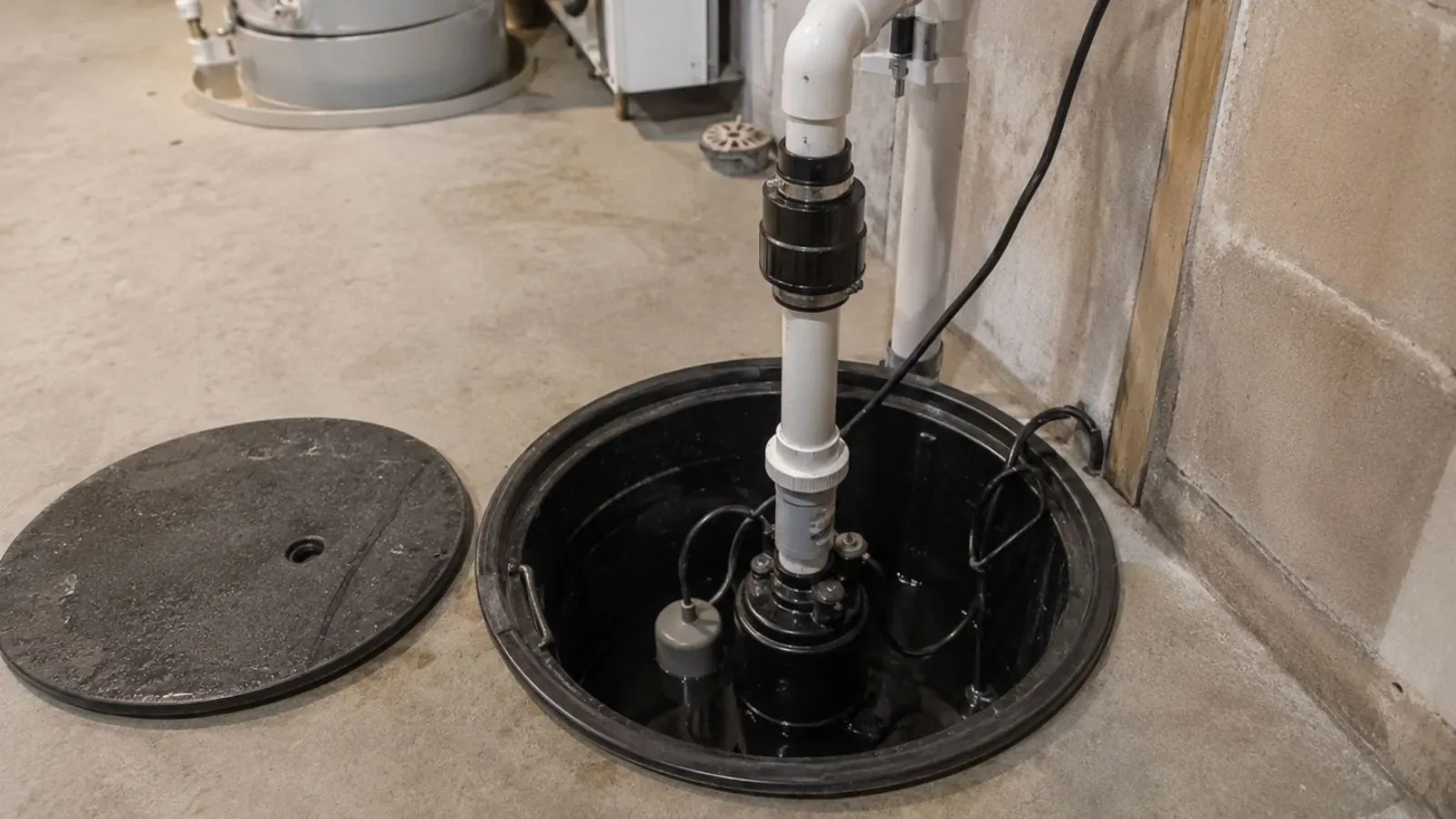
A silent pump with a full pit is a sump pump emergency in Firestone, CO, and our 24/7 line is the place to start. A sump pump moves groundwater out of a pit in the basement or crawlspace and away from the house through a discharge pipe. We handle the plumbing side of it: the pump, float, check valve, discharge line, battery backup, and sewage ejector.
While you wait, keep power cords and extension leads off the wet floor, and do not reach into a pit that stands in water with the pump still plugged in. Move belongings up off the slab and clear a path to the pit.
If you smell gas, leave the house and call the gas utility or 911 first. Structural cracks and soil problems are a different trade, and we say where our work ends.
Why a pump stops when you need it most
Pumps sit idle for months and then work hard in a storm. Most failures fall into a handful of causes.
Stuck float.
The float rises with the water and switches the pump on. If it snags on the pit wall or its own cord, the pump never starts.
Failed check valve.
This valve stops pumped water from falling back into the pit. A bad one makes the pump cycle over and over.
Clogged intake.
Silt, gravel, and debris can block the pump inlet, so the motor hums but moves little water.
Burned-out motor.
A pump that runs constantly or ran dry for long stretches wears out early.
Frozen or blocked discharge.
In winter the outlet pipe outside can ice over, which pushes the water right back into the pit.
Power loss.
Storms that knock out power also stop the pump. Without a battery backup, the pit fills quietly.
The pit is rising: what to do right now
Check the power first.
Look for a tripped breaker or an unplugged cord. Do this only if the floor around the outlet is dry.
Keep your hands out of the pit.
Never reach into water with a pump plugged in. Unplug it from a dry spot first.
Lift what you can.
Move boxes, furniture legs, and anything stored on the floor up onto shelves or blocks.
Bucket or wet vac as a bridge.
Bailing the pit buys time. Use only equipment that is rated for wet use, and keep cords up and dry.
Call and describe the sound.
Humming, clicking, silence, and gurgling each point at different parts, and it helps us bring the right ones.
Pit full and the pump silent?
Call us at (303) 552-3896 and describe the sound of the pump.
Quick checks before the plumber arrives
These checks take little time and sometimes solve it. Stop and call if anything is wet near an outlet.
- Pour water into the pit.A bucket of water raises the float. A working pump starts. Silence points at power, float, or motor.
- Look at the float.Make sure it moves freely and is not wedged against the pit wall or caught on the discharge pipe.
- Listen to the motor.A hum with no water movement often means a clogged intake or a seized motor.
- Walk the discharge line outside.Look for a crushed, frozen, or disconnected pipe where the water should come out.
Parts of the system and what each one does
| Part | Job | Signs of trouble |
|---|---|---|
| Pump | Pushes water up and out of the pit. | Hums but moves nothing, runs nonstop, trips the breaker. |
| Float switch | Turns the pump on and off with the water level. | Pump never starts, or never shuts off. |
| Check valve | Keeps pumped water from draining back. | Loud slam after each cycle, rapid cycling. |
| Discharge pipe | Carries water away from the house. | Ice, kinks, or pooling beside the foundation. |
| Battery backup | Keeps pumping when power is out. | Dead battery, alarm beeping, no run during a storm. |
Where the water goes after it leaves the pit
A sump pump is only as good as its discharge. If the pipe empties right beside the foundation, the water seeps back down and the pump runs again, endlessly. Routing it well away from the wall, and onto ground that slopes away, keeps the pit from refilling with the same water.
The Colorado Geological Survey says poor surface drainage and irrigation water reaching soil beside foundations drive many soil problems across the state. That is a statewide finding, not a statement about your lot, but it has a practical meaning here: a pit that fills every time the sprinklers run is telling you where the water comes from.
Rules about where discharge may go can vary, so ask the Firestone building division before routing it toward the street or a neighbor. In winter, a short underground or buried section helps keep the outlet from icing. Front Range freezes make that worth planning in advance.
Sump pump or sewage ejector pump
They look similar and do different jobs, so the right repair depends on which one you have. A rural parcel around Mead may be on septic instead of town sewer, so tell us which you have before we plan an ejector repair. A sewage ejector is plumbing that the 2021 International Plumbing Code (IPC) as adopted in Colorado covers, so a licensed plumber should do the work.
Sump pump
- Handles groundwater and clear drain water.
- Sits in a pit that collects seepage.
- Discharges outdoors, away from the house.
- Usually has a float and a check valve.
Sewage ejector pump
- Lifts wastewater from a basement bathroom or laundry.
- Sits in a sealed pit with a vent.
- Pushes waste up to the sewer or septic line.
- Needs gas-tight lid and careful handling.
Battery backup: what to confirm
Storms often cut the power that the main pump depends on. A backup pump with a charged battery is the usual protection.
- Battery age.Backup batteries lose strength over the years and should be tested on a schedule.
- A separate float.The backup pump needs its own switch, mounted a little higher than the main one.
- Its own discharge path.A backup that shares the main discharge needs a check valve of its own.
- The alarm.A high-water or power-fail alarm gives a warning you can act on.
Is it a pump problem or a water problem
A pump can work perfectly and still lose to heavy water. Anywhere in ZIP codes 80504 and 80520, a basement that takes in water faster than any pump can remove it is a drainage matter, covered under basement waterproofing. We will tell you when the pump is fine and the problem is outside.
If the water on the floor is clean and arrived without a storm, a supply line may be leaking instead. A leak search separates that from groundwater, and a split line needs burst pipe repair.
What changes the price of sump pump repair
Sump pump work ranges from a quick check valve swap to a full pump and battery install. The price is clear before work starts.
Water that backs up from a sump or drain is often excluded unless you added a specific endorsement. Ask your insurer how your policy treats it.
Want your real number? Name the pump type and what it is doing, and we spell out the price before starting. Call (303) 552-3896.
Questions about sump pump repair in Firestone
Yes. The line runs 24/7, and storms do not keep business hours. Call (303) 552-3896 and describe what the pump is doing.
If the pit is rising, bail it and keep cords dry until we arrive.
A stuck float or bad check valve is a modest repair. A burned motor or a pump that has run for many seasons is often better replaced. We tell you which makes sense on site.
Common causes are a stuck float, a failed check valve letting water fall back, or a water table that is simply high. Constant running wears the motor out, so it is worth a call.
If your pit fills during storms and the power goes out in the same storms, yes, it is a sensible add-on. A backup keeps the water moving when the main pump cannot.
It lifts wastewater from a basement bathroom or laundry up to the sewer line. It needs a sealed, vented pit. A failure there is more urgent than a sump failure because the water carries waste.
Yes. Water left in a long exposed outlet can freeze and block the flow. A short buried run, a proper slope, and a freeze-resistant outlet help.
It removes water that collects in the pit. It does not stop water from moving through the foundation, and exterior drainage and soil work belong to other trades.
Colorado licenses plumbers statewide through DORA, and its website lets you look up any license. The Firestone building division can tell you whether pump work needs a permit.