
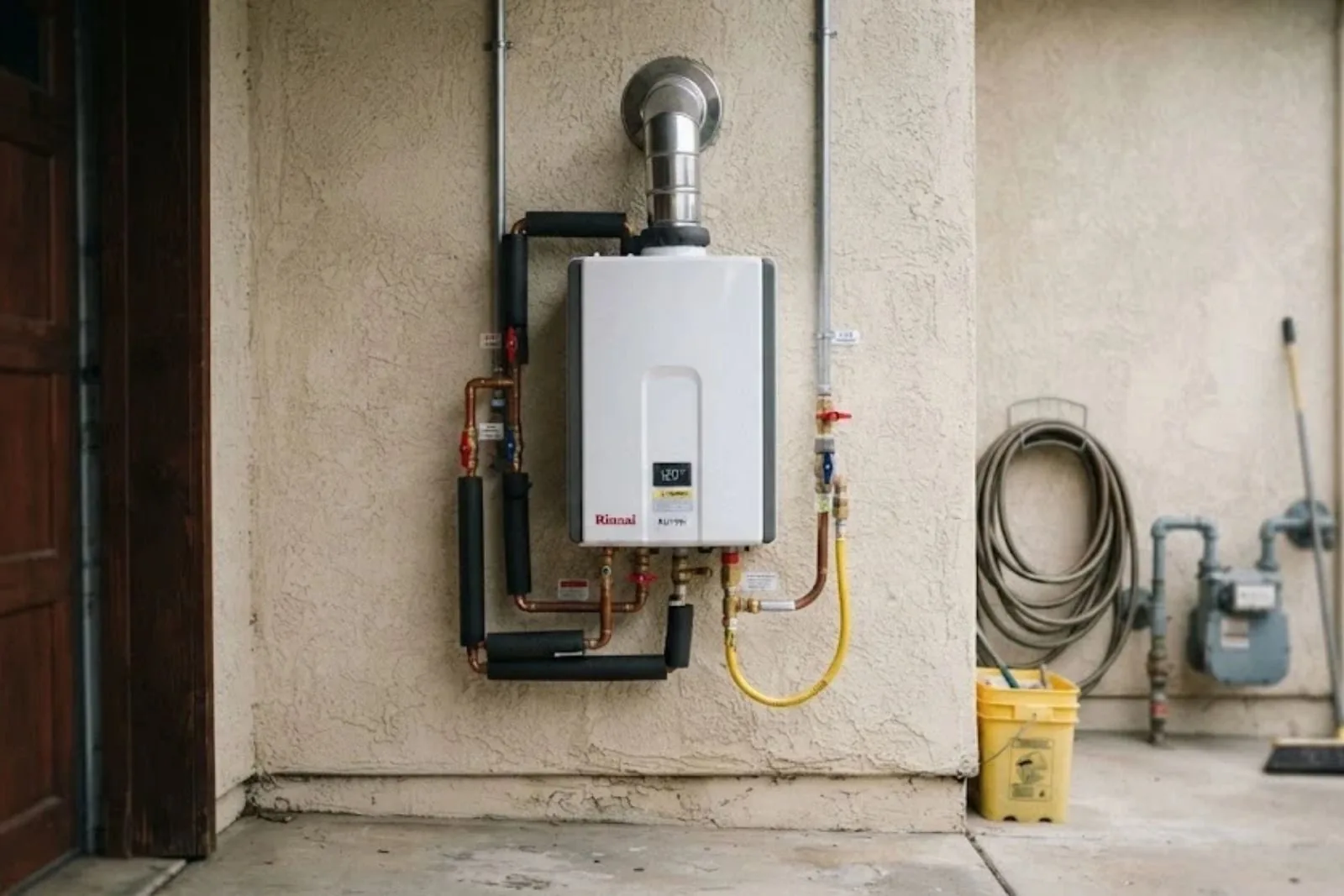
Firestone's treated water is on the soft side, which makes owning a tankless water heater in Firestone, CO easier than in towns with hard water. It does not make the unit maintenance-free. A tankless water heater heats water on demand as it passes through a heat exchanger, so there is no tank to store it, and the small passages inside are what need care.
This page covers what we do with these units: installs, repairs, flushes and descaling, error codes in general terms, and the venting and gas supply that make or break an install.
Owners in ZIP codes 80504 and 80520 call about the same few things. The water turns lukewarm, a code appears on the display, or the unit shuts off in the middle of a shower. Each has a usual cause, and most are easier to fix when caught early.
What local water does and does not change for a tankless unit
Scale is the main enemy of a heat exchanger. Minerals in hard water bake onto the hot surfaces, narrow the passages and make the unit work harder. That is why flush schedules matter more in hard-water areas.
The Central Weld County Water District 2025 report, using 2024 data, lists average total hardness at 33 mg/L, which it calls soft. The district reaches the Tri-Town area, so many Firestone addresses get that supply. In practice, scale should build slowly, and the maker's flush interval may be enough without a softener. The softener and filtration page explains how to test first.
Two cautions apply. The Town also buys water from the St. Vrain Water Authority, which reports no hardness figure, so ask which supplier serves your address and read its report. And the district uses chlorine, not chloramine, as its disinfectant. Neither fact is a reason to skip a flush, so treat them as background and follow your unit's manual.
How a tankless flush and descale is done
The exact method differs by maker, so the manual comes first. The general sequence looks like this.
- Shut off power, fuel and water.Turn off the electric supply or gas valve, then close the cold and hot isolation valves on the unit.
- Connect a pump and hoses.Service ports on the isolation valves let a small pump circulate cleaning solution through the heat exchanger and back to a bucket.
- Circulate the solution.A descaling solution or the maker's approved alternative loosens mineral buildup inside the exchanger.
- Rinse and clean the screen.Flush with clean water, clean the inlet filter screen, then reopen the valves and restore power or fuel and test.
Unit throwing a code?
Call (303) 552-3896 and tell us what the display says.
Reading error codes without guessing
Codes differ between makers, and your manual lists the exact meaning. These are the general families we see.
| What the unit shows or does | Usual area | What to do |
|---|---|---|
| Ignition failure code | Gas supply, igniter or flame sensor. | Check the gas valve is open, then call. |
| Vent or exhaust code | Blocked or damaged vent, or condensate trap. | Do not keep resetting it, and call. |
| Overheat or limit code | Scale, low flow or a failing sensor. | Call, a flush may be due. |
| Flow or temperature fault | Clogged inlet screen or mixing problems. | Clean the screen if the manual allows, then call. |
| Unit cycles off mid-shower | Low flow, scale or a gas supply that falls short. | Describe the pattern when you call. |
Resetting a code once is fine. If it returns, the cause is still there, and repeated resets can mask a safety issue.
Venting and gas supply: where tankless installs go wrong
Tankless units burn a lot of fuel in a short burst. A gas line sized for an old tank heater may not deliver enough, and the unit then shuts down or runs rough.
Venting is the other pressure point. Some units use plastic vent pipe and drain a condensate line, and others use stainless vent that needs different handling. A wrong vent type or a bad slope can leak exhaust or let condensate back up. Licensed plumbers work to the 2021 International Plumbing Code (IPC) as adopted in Colorado, so ask them to confirm vent type and slope before you buy.
Plan for both before you buy. If you smell gas near any gas appliance, leave the building and call the gas utility or 911 first. The planning side of a new unit is covered on the installation page, including permit questions to take to the Firestone building division.
Signs a tankless unit is asking for service
- Water takes longer to warm up.Scale or a clogged screen can reduce flow through the exchanger.
- Temperature swings during a shower.A dirty sensor, low flow or a scaled exchanger can cause the output to drift.
- A kettle-like rumble or ticking.Mineral buildup can make the unit noisy as water passes through.
- A code that keeps coming back.A one-time code can be a blip. A repeat code means a real cause.
- Longer time since the last flush.If you cannot remember when the unit was last flushed, it is probably due.
Tank versus tankless in a typical Firestone house
Neither is better in every house. The choice depends on space, gas supply and how hot water gets used.
A storage tank tends to suit
- Homes with a gas line sized for the tank.
- Households with many overlapping hot water uses.
- Owners who want the simplest, least-maintained setup.
- Quick like-for-like swaps.
A tankless unit tends to suit
- Houses short on space for a tank.
- Steady, spread-out hot water use.
- Owners willing to flush the unit on schedule.
- Homes where the gas line and vent can be upgraded.
Why hot water can cut out at low flow
Tankless units need a minimum flow to fire. Open a faucet only a little, and the burner may not light or may shut off. This is normal for the design, not necessarily a fault.
A short burst of cold water between hot uses is another common complaint. Water already in the pipe cools, then the unit starts again. A recirculation setup can reduce it, so ask us if long waits are the problem. If the pattern changed recently, a repair visit may find the cause.
If the pipes themselves are old or restricted, hot water delivery suffers whatever the heater does. Corroded lines are a question for repiping, not for the heater.
What changes the price of tankless water heater
Tankless pricing depends on the job and the house. You hear it before work starts.
Insurance usually addresses sudden damage, such as a burst line, and not wear or scale inside a heater. Ask your insurer how your own policy treats this.
Want your real number? Give us the make of the unit and its symptoms. Call (303) 552-3896.
Questions about tankless water heater in Firestone
Follow the maker's interval in the manual. Soft supply water from the district means scale should build slowly, but a periodic flush still matters. Ask us what fits your unit.
The Central Weld County Water District reports soft water at 33 mg/L average. The St. Vrain Water Authority gives no figure, so check which supplier serves your address, and test before buying equipment.
Codes vary by maker, so the manual has the exact meaning. In general they point to gas supply, ignition, venting, overheating or flow. Clear it once, and call if it returns.
Maybe. Tankless units draw more fuel at once than most tanks. A plumber has to check the line size and length before the unit is chosen.
Yes, and the type depends on the model. Condensing units use plastic vent and a condensate drain, while others use stainless vent. The wrong choice can leak exhaust.
Yes in many houses, though gas, vent and sometimes electrical changes come with it. We go over what your home needs by phone before pricing.
Yes, service extends to Frederick, Dacono, Erie and Mead. Have your address and the unit's brand handy.