
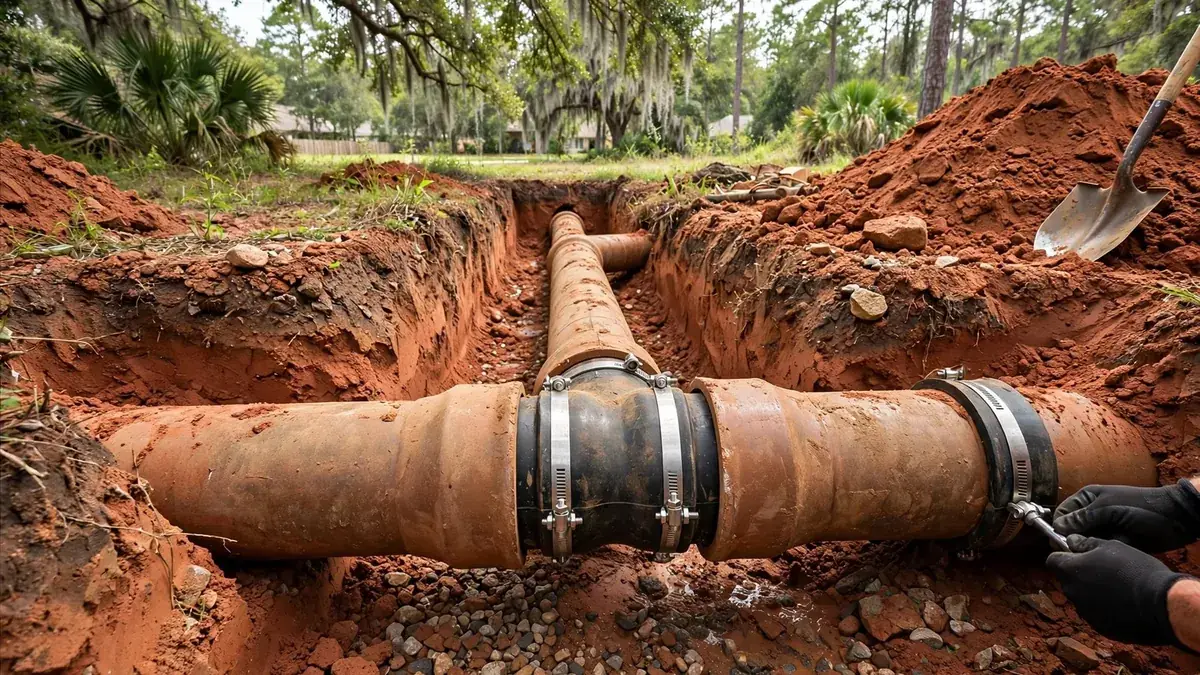
A sewer line that has cracked, collapsed, or shifted lets wastewater back up into the house or leak into the soil, and our 24/7 emergency line takes those calls. Sewer line repair in Firestone, CO means fixing or replacing the failed section of pipe that carries waste from your home to the municipal main. Until we arrive, use no water, stay out of the wet area, and keep hoses away from every drain.
Repair is a different job from clearing. If a cable or jet opens the line and it stops up again soon, the pipe itself is usually the problem. A camera tells us where the damage is and why it happened.
A sewer backup that keeps returning
One backup can be a wad of paper. A second backup within a few weeks, in the same fixtures, almost never is. At that point we stop treating it as a clog and start looking for a broken, sagging, or root-filled section of pipe.
The pattern helps us. A blockage that returns at the same spot points to a single failed joint. Slow drains across the whole house point to a pipe that has lost its shape along a longer run. Tell us what the house has been doing, because that history narrows the search before the camera goes in.
If the line is blocked right now, we may need to open it first so the camera can see. That is a sewer line cleaning step, and it is usually part of the same visit.
Repair options and where each fits
| Method | Best fit | Limits |
|---|---|---|
| Spot repair | One cracked or rooted joint, with the rest of the pipe sound. | Does not help a pipe that is failing along its whole length. |
| Trenchless lining | Long runs with small cracks or root entry and a pipe still round. | Needs a clear line and cannot fix a collapsed or heavily offset pipe. |
| Open-trench replacement | Collapsed, sagging, or crushed pipe | Digs up the yard or driveway, and takes more time. |
| Cleanout installation | Lines with no good way in. | Adds access but does not repair damage. |
| Lateral replacement | A line failing in many places. | Largest job, chosen only when spot work will not hold. |
Lining under a slab is possible in some cases. Ask us, and the camera video tells us if your pipe is a candidate.
Sewage backing up into the house?
No water use, then call (303) 552-3896 any hour.
While a sewer backup waits for a plumber
Stop every fixture.
Do not flush, shower, or run the washer. Even a small amount of water adds to the problem.
Keep everyone out of the soaked room.
Wastewater is a health concern. Shut the door and send kids and pets elsewhere.
Protect what you can.
Lift rugs and boxes off the floor. Do not use a household vacuum on standing sewage.
Stay clear of wet electrical.
Water near outlets, cords, and a panel is a hazard. If it is spreading toward electrical, tell us.
Gas smell means leave.
Natural gas has a different smell and a different risk. Leave, and let the gas utility or 911 know first.
Dig it up or line it
The camera video decides this, not a preference.
Open trench makes sense when
- The pipe is collapsed, crushed, or badly offset.
- A section sags and holds water.
- Roots have destroyed the pipe wall.
- A short dig reaches the problem easily.
Lining makes sense when
- The pipe is round and mostly intact.
- Damage is spread along a long run.
- Digging would tear up a driveway, patio, or mature trees.
- Access from a cleanout is good.
What actually breaks a sewer line
Roots.
They slip into a joint and keep growing, which cracks the pipe wall and catches debris. A jetting pass clears them only for a while.
Offset joints.
When two pipe sections shift apart, a lip forms that catches paper and slows flow.
Corroded cast iron.
Old cast iron rusts from the inside out and flakes into the stream.
Bellies.
A low spot holds water and solids, so the line fills and then stops.
Crushed pipe.
Heavy loads over a shallow section or soil settling can flatten the pipe.
Soil movement.
Ground that swells and shrinks can pull on a rigid pipe, and joints are where it gives.
Cast iron and clay in older Firestone homes
The original townsite was platted in 1907, from Grant Avenue to McClure Avenue and from First Street to Fourth Street. Houses there are far older than most of town, so the sewer lateral may be cast iron or clay with many joints. More joints means more places for roots to get in, and we plan on a camera look before quoting a fix.
Most Firestone homes were built after 2000, and their sewer pipe is usually newer material. Failures there more often come from a bad joint, a sag from poor backfill, or soil that settled. Homes in ZIP codes 80504 and 80520 mix both eras, so the age of the house is the first thing we ask.
Permit rules vary, so ask the Firestone building division before any dig. The Town checks that permitted plumbing work lists a licensed plumber, and you can verify any plumber on the state DORA license lookup. Repairs follow the 2021 International Plumbing Code (IPC) as adopted in Colorado, the base code the Town enforces through permits and inspections.
Soil, sprinklers, and downspouts around the sewer
The Colorado Geological Survey calls expansive clay the state's most significant geologic hazard. Soil can swell by 10 percent or more when wet, and the usual cause is surface water and irrigation soaking in beside a foundation. That is a statewide statement, not a ruling on your lot.
What it means for a sewer line is practical. Pipe that sits in soil that swells and shrinks sees stress at the joints, so a sprinkler head that soaks one side of the house every morning is worth fixing.
We do not diagnose soil movement, since a soil engineer does. We do fix the pipe, and we talk about drainage so the repair does not fail for the same reason, and our basement waterproofing page covers the plumbing side of it.
Getting ready for a repair visit
- Write down what the house did.Which fixtures backed up, when, and whether it was before or after a heavy use day.
- Find the cleanout.Any past camera or cleaning invoice may note where the plumber got in.
- Know your property lines.A break may sit in the yard, under a driveway, or near a neighbor. Tell us what you know about shared lines.
- Mark sprinklers and buried lines.A repair that digs needs to avoid irrigation lines and utilities.
- Plan for the yard.A dig can cover turf or hardscape. Tell us if something in the path matters to you.
If your property is on septic
Not every property in the area is on a sewer main. Some rural parcels around Mead and in unincorporated Weld County may use a septic tank and drain field, and the repair path is different. The Weld County Building Department covers codes for unincorporated parcels.
Tell us at the start of the call if your property is on septic. A backed-up septic system and a failed sewer lateral can look alike, and the right plumber depends on the answer.
What changes the price of sewer line repair
Repair prices differ more than cleaning prices, because the work can range from one joint to a whole lateral.
A sudden break from a covered event may be handled differently than damage from roots or age. Read your own policy, and ask your insurer before work if coverage matters, because we cannot speak for them.
Need a real number for your sewer? After the camera look, you get a clear price before work starts. Call (303) 552-3896.
Questions about sewer line repair in Firestone
Our 24/7 line is staffed every hour. Call (303) 552-3896 and tell us what is happening. If the main is blocked right away, clearing it often comes before the repair plan, and we can talk through scheduling that day.
We run a camera through the line and watch the monitor. A location device on the camera head lets us mark the break at the surface, so a repair does not mean digging the whole yard.
Often yes, if the damage is at one or two joints. We clear the roots and then repair or line the pipe. If the pipe has lost its shape along its whole length, replacement is the honest answer.
When the video shows a line failing along most of its length, yes. We explain why, and you decide. A spot repair is the right call when the rest of the pipe is sound.
Sometimes. Lining works when the pipe is still round and the line is clear. A camera look first tells us if your pipe is a candidate, and we say so honestly if it is not.
Many do, especially those built long before the recent growth. Cast iron can corrode from the inside, and we check it by camera. If you have an older home in the original townsite, mention it on the call.
Yes, we need the video to plan. If you only want the video, a sewer camera inspection can be booked alone.
A soil engineer identifies that hazard. We fix pipe that has failed, and we talk about irrigation and drainage so the repair holds.