
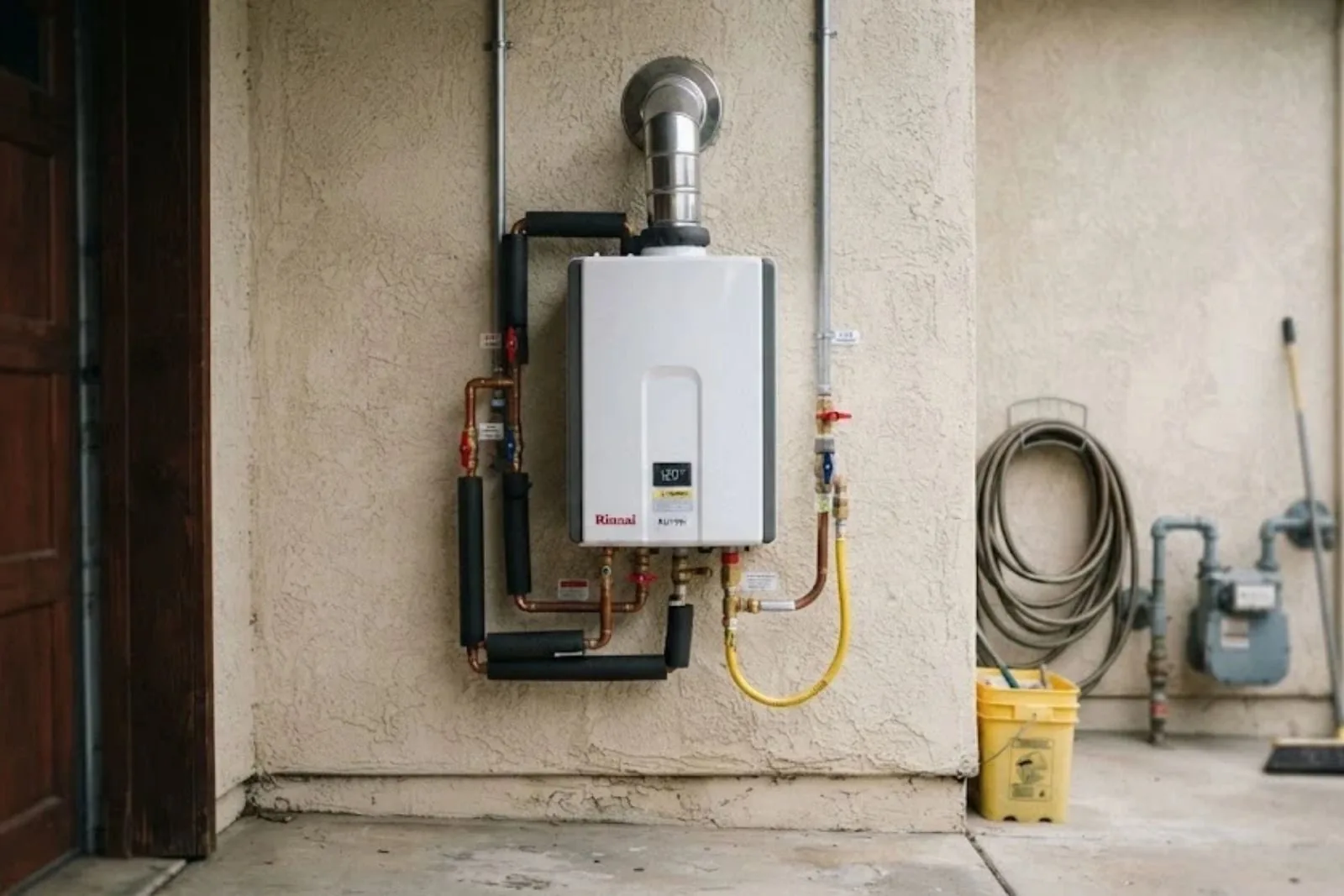
The cost of putting in an on-demand water heater in Firestone depends on the house more than the unit. Gas line size, venting, where the heater will hang, electrical supply, and permit steps move the price the most.
Nobody can give an honest number without knowing what you have now. Phone (303) 552-3896, describe your current heater and gas meter, and ask for the full price in writing or by voice before any work begins.
Why two tankless jobs never land at the same price
Two neighbors can buy the same model and get very different final bills. The heater itself is one line on the job. The rest is everything that has to change in the house so the unit can run safely.
A tank heater sits on the floor, burns a small flame, and vents up a short flue. An on-demand unit fires hard for short bursts, so it asks more of the gas supply, the vent path, and the walls around it. Each of those can be fine already or need work.
That is why a price given over the phone without questions should make you cautious. A good estimate starts with what is on the wall today, not with a model number.
The main cost drivers and the question each one raises
Use this table as a script when you compare any two prices for the same job.
| Cost driver | What makes it bigger or smaller | Question to ask |
|---|---|---|
| Gas line size | A larger burner needs a wider pipe and enough meter capacity. An older, narrow line may need upsizing. | Is my current gas line big enough for this unit? |
| Venting | A new vent route through a wall or roof adds material and labor. Reusing a compatible vent path costs less work. | Will the old flue be reused or replaced? |
| Location | Moving the heater means new water, gas, and vent runs. A swap in the same spot is simpler. | Does this price include relocating the unit? |
| Electrical | Most units need power for the fan and controls. A nearby outlet is easier than a new circuit. | Do you need an outlet or a new circuit? |
| Permits and inspection | Permit rules vary, and the Firestone building division decides what applies to your address. | Who pulls the permit and is inspection included? |
| Old unit removal | Draining, disconnecting, and hauling away a tank adds steps. | Is removal part of the price? |
If a price skips any of these rows without saying why, ask what was assumed.
Gas line size is the first thing a plumber checks
An on-demand heater can ask for several times the gas flow of the tank unit it replaces. The pipe that fed a small tank burner may be too narrow, and the meter itself has a limit. Your plumber measures the run from the meter to the heater and counts everything else that shares that line, such as the furnace, range, and dryer.
If the line is too small, upsizing is the usual fix. Long runs and many elbows make it larger. This is also where the gas utility can get involved, since the meter belongs to them.
Gas work is not a place for guessing. If you ever smell gas, leave the house first, then call the gas utility or 911 from outside. Do not flip switches or look for the source yourself.
Venting changes the job more than most people expect
Every gas heater has to move exhaust outdoors, and on-demand units do it with a fan and a specific kind of pipe. If the old flue cannot be reused, new vent pipe has to run through a wall or the roof. Longer routes with more turns usually mean more cost and sometimes a different pipe size.
The full rules for vent clearances come from the manufacturer instructions and local code, not from a rule of thumb. Your installer should name the vent type in the price. Ask whether it is a single-pipe or two-pipe system, because that tells you how many holes go through your house.
What to have ready before you call
A few minutes of looking saves back-and-forth on the phone.
- Photo of the current heater.Include the data label, the flue, and the pipes on top.
- Where you want the new unit.Same spot, another wall, garage, or basement. Say if the space is tight.
- Your gas appliances.List the furnace, range, dryer, and anything else on the same gas line.
- Nearby outlets.Note whether there is a grounded outlet within reach of the planned spot.
- Household hot water use.Count bathrooms and how many fixtures run at once on a busy morning.
Electrical, condensate, and the small parts that add up
Even a gas unit needs electricity for its fan and controls. If there is no outlet close by, an electrician or a licensed plumber with the right scope has to add one. Ask who handles that so it does not become a surprise visit.
High-efficiency models make acidic condensate and need a drain for it. Sometimes a nearby floor drain or laundry standpipe works. Other times a small neutralizer and a pump are needed, which adds parts.
Then there are isolation valves, a pressure relief line, and sometimes an expansion tank. These are small items, but they should appear on the price so you can compare fairly. A cheaper offer that leaves them out is not cheaper. Licensed plumbers work to the 2021 International Plumbing Code (IPC) as adopted in Colorado for relief piping, so a price that skips it is incomplete.
How to get a clear price by phone
The goal is a number that holds up when the plumber stands in your utility room.
- Describe what you have.Give the age, type, and location of the current heater and how it vents.
- Say what you want.Name the model if you picked one, or ask what size suits your household.
- Ask what is included.Run down the table above: gas line, vent, electrical, drain, permit, removal.
- Get the assumptions named.Ask what would change the price once the plumber sees the space.
- Confirm before work starts.A clear price before work starts is the standard to expect from any plumber.
Like-for-like swaps and moves are different quotes
Replacing a tank with an on-demand heater on the same wall is its own category. Moving to a garage or a closet is another. If you are weighing both, ask for each as a separate line, and read about planned heater installations first to see which questions matter.
The service page on tankless water heaters also covers flushing and error codes, which affect the long-term cost of owning one.
What this means for a Firestone, CO install
Most homes in Firestone were built after 2000, so many have modern gas piping and a layout that suits a wall-hung unit. The original townsite homes are far older, and their gas lines and flues deserve a closer look before you assume a swap is simple.
Permit rules vary, so ask the Firestone building division what applies to your address. Permits that need a licensed plumber must list the plumber and the state licence, and the Town checks it through the DORA lookup. Ask your installer to show you that licence number up front.
Water from the Central Weld County Water District is soft, with an average hardness of 33 mg/L in its 2025 report. Scale builds more slowly in that water, but ask which supplier serves your address, because Firestone and St.
Vrain Water Authority do not report a hardness figure. Neighbors in Frederick face the same supplier question. For a tankless install in Mead, the property type changes the gas and permit picture, so say if you are on a rural lot.
Questions homeowners ask
Often yes, because of the gas line, vent, and condensate work. A like-for-like tank swap has fewer moving parts. The gap shrinks if your house already has the right gas pipe and vent path.
Sometimes. Tank flues are usually a different pipe and size than what an on-demand unit needs. The installer reads the manufacturer instructions and checks the old path before saying yes.
Usually not, but the meter has a flow limit. Your plumber adds up your gas appliances and tells you if the gas utility has to be involved.
Yes, permit rules vary and the division decides for your address. Ask them directly or have your plumber confirm what applies before the work is scheduled.
No. Soft water slows scale, but it does not stop it, and some Firestone addresses may be served by a supplier with harder water. Flushing schedules come from the manufacturer.