
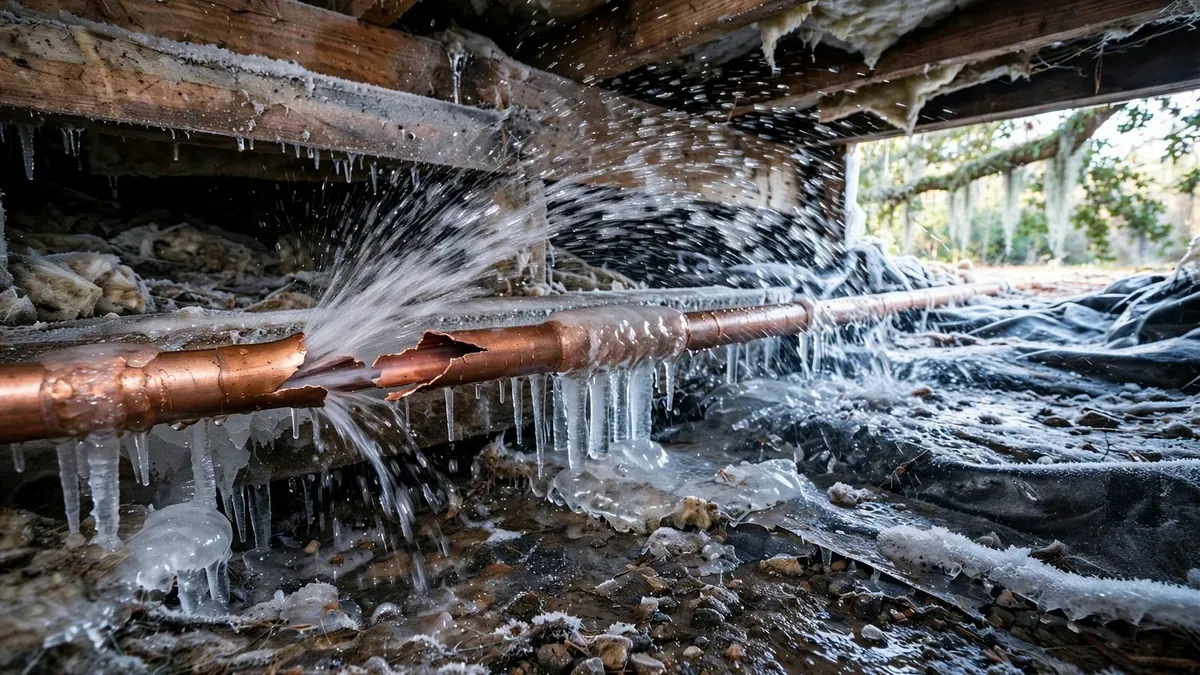
Your main shut-off is usually where the water line enters the house. Check a basement or utility room wall facing the street, a garage, or a crawlspace. Turn a lever handle a quarter turn until it sits across the pipe. Turn a round handle clockwise until it stops.
Open a low faucet to drain the pipes, and keep everyone away from wet electrical areas. If the water will not stop, call for burst pipe repair and keep trying other shut-offs.
Closing the valve in the right order
Do this the moment water is where it should not be.
- Find the valve.Look where the pipe enters the house. In a basement, it is often on the front wall near the water meter or pressure regulator.
- Turn it fully.A lever handle turns a quarter turn. A round wheel turns clockwise and may take several full turns.
- Open the lowest faucet.This drains the pipes and lets you confirm the flow has stopped.
- Shut off the water heater.Turn a gas unit to its pilot or off setting and flip an electric unit's breaker, so it does not run with the tank empty.
- Make the call.Photograph the damage for your own records and call a plumber.
Where the main valve tends to hide
Search in this order if you have never found yours.
Basement or utility room.
Often on an exterior wall that faces the street, near a meter or a pressure regulator.
Garage.
Look near the water heater or on the wall closest to the front of the house.
Crawlspace.
Follow the main line from where it enters through the foundation.
Laundry or mechanical closet.
Slab homes often put the entry point in an interior closet.
Outside by the meter.
A buried box or pit near the street or sidewalk holds the meter and the utility's valve.
Ball valves versus gate valves
The handle tells you which kind you have.
| Type | What the handle looks like | How it behaves |
|---|---|---|
| Ball valve | A flat lever | Quarter turn, closed when the lever crosses the pipe. |
| Gate valve | A round wheel | Several full turns clockwise, can stick or fail to seal with age. |
| Meter-side valve | A flat tab or stop on the meter. | Belongs to the utility, so do not force it. |
Never use a wrench on a gate valve wheel or force it past resistance. A stripped stem can leave you with no shut-off at all.
The valve at the meter versus the valve in the house
There are usually two shut-offs. One is at the meter, in a buried box or pit outside. The other is the homeowner's valve inside, near where the pipe enters the house.
The inside valve is yours to use. The valve at the meter belongs to the utility. Using it without permission can damage it, and it often needs a special key.
If the inside valve will not turn or does not hold, call your water utility about the meter-side valve and call a plumber about replacing yours.
After the water is off
The next ten minutes matter.
- Keep away from wet electrical items.Do not touch outlets, cords, or panels near standing water. Turn off the breaker only if you can reach it dry.
- Move belongings.Lift rugs, boxes, and anything porous off wet floors.
- Do not use drains.If water came in from a drain line, flushing and running sinks can make it worse.
- Take photos.Record damage and the leak source before cleanup, for your own records and your insurer.
- Check for a hidden leak.If no fixture is running and the meter still moves, a pipe may be leaking. Our leak detection page explains how that is found.
Why you should turn the valve before you need it
A valve that has not moved in years can freeze in place from mineral buildup. A gate valve in particular can seize or leak at the stem when it is finally turned.
Twice a year, close it fully, then open it again. Do it slowly and expect a faint leak at the stem to be a sign that the packing nut or the valve itself needs attention. If the valve is stiff, leave it and have a plumber replace it while the water is not pouring out of a pipe.
When the valve itself is the problem
A valve that drips at the stem, feels gritty, or does not stop the flow completely is wearing out. Closing it harder will not help and can break it.
Replacing a main valve means the water to the whole house has to be off while the work is done. That is a job for a licensed plumber, and a ball valve is the usual upgrade because it closes in a quarter turn.
If your house has only a gate valve, ask the plumber about swapping it while there is no emergency. A calm hour beats a flooded floor.
Teach everyone in the house
One person knowing where the shut-off sits is not enough. Show every adult and older child the valve and let them turn it once. Add a bright tag to the handle.
Keep the path clear. Boxes stacked in front of a valve will cost you the minutes you do not have.
What this means in Firestone, CO
The Town buys treated water from two sources, so who owns the meter-side valve depends on your address. Ask your water utility before you touch anything at the meter. Ask your water provider for its own guideline on that valve, because operating the wrong one can damage it.
The original townsite holds Firestone's oldest houses, while the bulk of town went up after 2000. An older house is more likely to have a gate valve, so test it now instead of during an emergency.
If you live near Mead on rural land, ask which provider serves you, because the setup can differ. Homes in Dacono may also have a meter-side valve that belongs to the provider, so check before you turn it.
Questions homeowners ask
Do not force it. Try any other shut-off you can reach, such as a fixture stop or a shut-off at the water heater, and call a plumber.
If you suspect the meter valve is the only option, call your water utility.
The valve at the meter is the utility's equipment. Do not open the lid or force a shut-off without asking the utility.
Open the lowest faucet. Water should run for a few moments and then stop. If it keeps running, the valve is not holding.
Twice a year is a common habit. Close it fully, open it fully, and back it off a little if the maker advises.
Call your water utility, since Firestone buys from more than one supplier and which one serves you depends on your address. Then call a plumber for the inside valve.
Do not try to work on the meter yourself.