
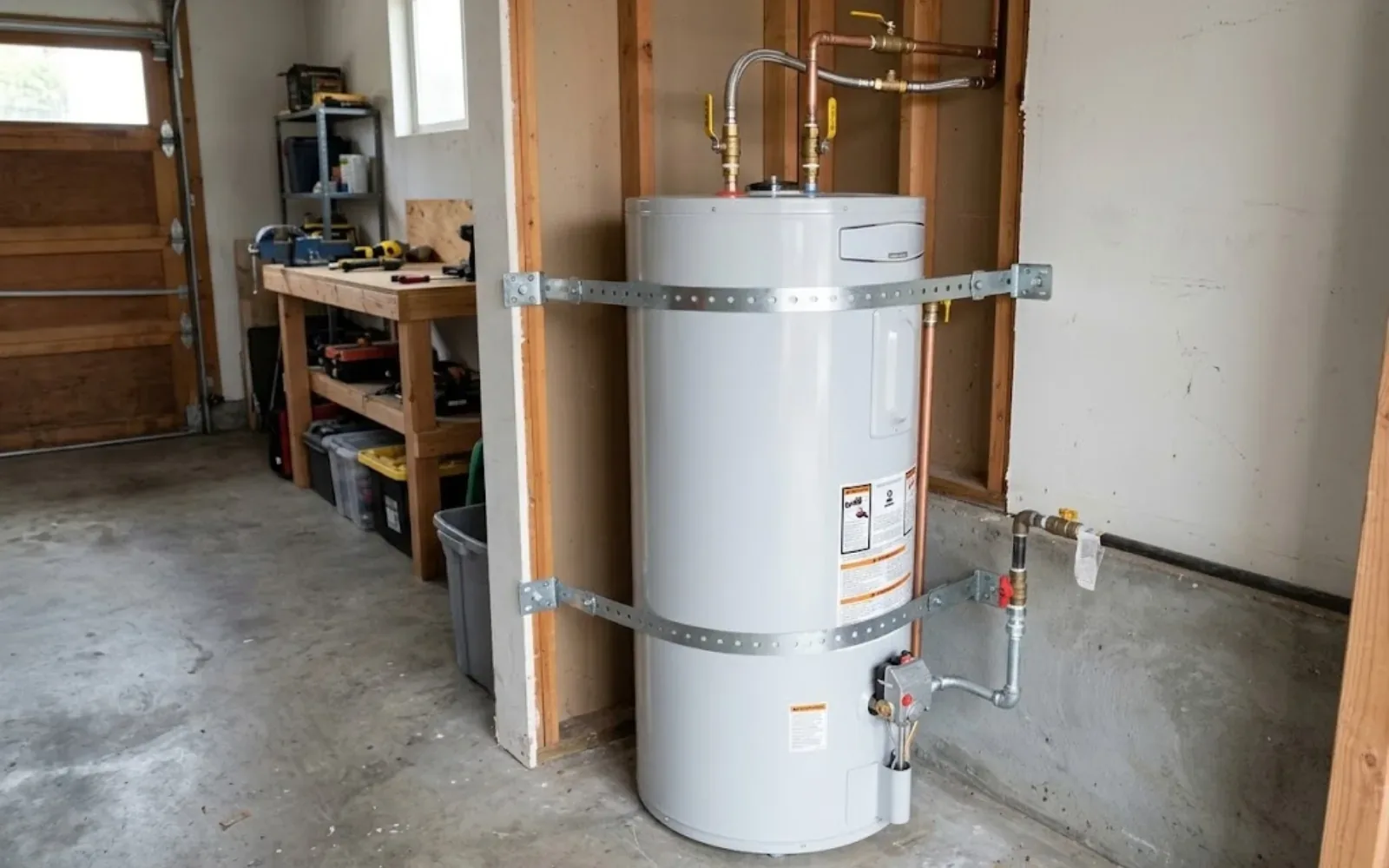
There is no single time that fits every house. A like-for-like tank swap in an easy spot is simpler than a tankless conversion with new venting, a new gas line, or a moved location.
Time depends on access, venting, utilities, and any permit or inspection step. Call (303) 552-3896, describe your setup, and ask the plumber to explain the steps for your house.
Four things set the pace of a replacement
The first is access. A heater in an open utility room is quick to reach, while one in a tight closet or crawlspace slows everything. The second is the match between the old and new unit. Same fuel, same size, same connections go faster.
The third is what the house needs to change, like a new vent, a bigger gas pipe, or a new electrical circuit. The fourth is paperwork and inspection, which has its own schedule that the plumber does not control.
Tank swap versus tankless conversion
The work behind each is quite different, so the schedule is too.
Tank for tank
- Drain and disconnect the old unit.
- Move the new tank into place.
- Reuse or update the flue and gas connection.
- Reconnect water lines and relief valve.
- Fill, light or power up, and test.
Tank to tankless
- Mount a wall unit and run new water fittings.
- Size and route a new vent.
- Check the gas line and upsize if needed.
- Add power and a condensate drain if required.
- Commission the unit and walk you through it.
What stretches or shortens the job
Match your home to the rows and you will see why answers differ.
| Factor | Keeps it simple | Adds steps |
|---|---|---|
| Location | Open room, short carry | Tight closet, stairs, crawlspace. |
| Fuel | Same fuel as before | Switch between gas and electric. |
| Venting | Flue is sound and reusable | New route or liner needed. |
| Gas or power | Existing lines are right-sized | Upsized pipe or new circuit. |
| Water lines | Shutoffs work, pipes in good shape. | Stuck valves or corroded fittings. |
| Permit and inspection | Rules are clear for the address. | Inspector scheduling or corrections. |
Tell the dispatcher which column describes your house and ask what changes.
Why a promised window can mislead you
Some companies quote a short window to win the call. The honest part is that the old unit has to come out before anyone sees the connections behind it. Rusted fittings, stuck valves, and a flue that has to be redone are common finds.
A better question than how long is what could slow it and what you would be told about it. A plumber who answers that clearly is planning for your house, not reading from a script.
Venting, gas, and electric are where surprises live
Old flues can be rusted, undersized, or routed in ways that do not suit a new unit. Once the old heater is out, the plumber can see what the vent really looks like. That may add work that no phone call could predict.
Gas lines and shutoffs are the same story. A line that was fine for the old tank may need changes for a new model. If there is any smell of gas at any point, everyone leaves the house and the call goes to the gas utility or 911 from outside.
What happens, in order, on a typical replacement day
The pace varies, but the order rarely does.
- Walk-through.The plumber looks at the old unit, vent, valves, and the space around it.
- Shut off and drain.Water and fuel are turned off, then the tank is drained to a safe spot.
- Remove and place.The old unit goes out and the new one is set level on its pan or wall bracket.
- Connect and test.Water, fuel, vent, and relief lines are connected and checked for leaks.
- Start up and explain.The unit is lit or powered, set to a safe temperature, and shown to you.
Electric and heat pump units have their own timing questions
An electric tank needs a circuit that matches its heating elements. If the breaker, wire, or outlet is wrong for the new unit, an electrician's step comes first. Ask whether that is already handled or still ahead of you.
Heat pump models add more questions. They need room around them for airflow, a drain for the condensate they make, and often a space that stays within a workable temperature range. We only mention them as an option here, and a plumber has to see the room to say if one fits.
The more your answer differs from a plain swap, the more you should ask for the plan in steps and not as a single time. That way you know what could change on the day.
Permit and inspection questions to settle before the day
Permit rules vary, so ask the Firestone building division what your address needs. If a permit applies, a licensed plumber's details go on it, and an inspection may follow. Ask who requests that inspection and whether the water heater should stay accessible until it passes.
This is the part that most often surprises people. The plumber can finish the install, but a final sign-off may have its own timing. Ask how the plan handles it.
How to prepare so the visit goes smoothly
A little prep removes small delays.
- Clear a path.Move boxes and furniture between the door and the heater.
- Locate the main water shutoff.Know where it is and that it turns.
- Plan for no hot water.Shower and laundry timing change while the unit is out.
- Note the old unit's label.Take a photo of the size, fuel type, and model.
- Secure pets and kids.Open vents and hot pipes are not safe spaces to wander.
If your tank is already leaking
A leaking tank moves the question from planning to damage control. Shut off the water to the heater, cut power or gas as the unit allows, and call. Learn more on water heater replacement and, for planned work, water heater installation.
What this means in Firestone, CO
Firestone's permit guidelines require that permits for licensed work list the plumber and the state licence number. The Town checks that licence, often through the DORA online lookup, and inspectors can fail an inspection if they cannot verify the plumber. Ask your installer for the licence details before work begins so nothing stalls at sign-off.
Inspections are done by the Town or its partner SAFEbuilt, and the Firestone building division is the place to ask what applies. The base code behind those inspections is the 2021 International Plumbing Code (IPC) as adopted in Colorado, so ask what the inspector will look at before the heater is closed in. If you live nearby in Frederick, your own town sets its own rules, so ask there instead.
For a heater swap in Mead, add one question about whether the town or the county handles the permit.
Questions homeowners ask
Usually yes, and it saves handoffs. The plumber you pick should handle removal, install, and testing as one job.
Ask for the plan at booking. A tank swap often returns hot water sooner than a conversion, but we do not promise a time because every house is different.
It can, since it needs space, a drain for condensate, and electrical supply. Ask your plumber to look at the room before you pick a model.
Ask the plumber and the Firestone building division at the start. The answer tells you what happens after the install is done.
Yes. Colorado licenses plumbers at the state level, and the DORA online lookup lets you check a licence yourself. Firestone permit guidelines call for the number to be listed.